
Have questions?
support@reservepowerco.com
support@reservepowerco.com
support@reservepowerco.com
support@reservepowerco.com

The most common mistake buyers make when choosing a portable power station is sizing it for best-case conditions. They estimate their fridge draw in mild weather. They assume every day will be sunny. They choose a station that barely covers their calculated load, leaving no buffer for the days when their actual draw exceeds the estimate. And then they wonder why the system runs out of power by night three of a trip or before the second day of a storm outage.
This guide covers the complete sizing framework we use with every customer at Reserve Power Co. It starts with calculating your real daily draw, accounts for the variables most guides skip, walks through solar sizing, and ends with a product mapping table so you can match the math to a specific station.
 Step 1: Calculate your real daily Wh draw
Every sizing decision starts with a single number: your daily watt-hour draw. This is the sum of every device you run, multiplied by the hours per day you run it. It needs to reflect your actual usage under real conditions, not ideal ones.
Here is how to build the calculation:
A realistic example for a full-time van lifer or extended camping setup:
| Device | Watts | Hours/day | Daily Wh |
|---|---|---|---|
| 12V compressor fridge (45L, summer conditions) | ~65W average cycling | 24 | ~650Wh |
| Laptop (full workday) | ~65W | 8 | ~520Wh |
| Mobile hotspot | ~10W | 10 | ~100Wh |
| Phone charging (x2) | ~40W combined | 2 | ~80Wh |
| LED lighting (evening) | ~30W | 4 | ~120Wh |
| Fan (overnight) | ~25W | 8 | ~200Wh |
| Camera/drone charging | ~65W | 1 | ~65Wh |
| Total | ~1,735Wh/day |
Note the fridge is listed at 65W average cycling in summer conditions, not the 45W average often cited in spring or fall. This is the single most important adjustment most guides miss.

If you are using your system in summer months, or in hot climates year-round, your fridge draw estimate needs a heat adjustment before you use it for sizing. A compressor fridge that averages 45W per hour in 65F ambient conditions averages 60 to 70W in 85F to 95F conditions. The compressor runs more frequently and for longer cycles to maintain the target internal temperature against the higher ambient heat.
The practical rule: add 30 to 40% to your estimated fridge draw if you are planning for summer use. For a fridge estimated at 45W average in spring, use 60 to 65W for summer sizing. For a fridge estimated at 150W average draw at home in winter, use 195 to 210W for summer. This adjustment is the difference between a system that keeps up and a system that falls behind by midday.

The rated watt-hour capacity printed on a power station is a lab-condition number, measured at ideal temperature and discharge rate. Real-world usable AC output is lower, because converting DC battery power to AC outlet power is not 100% efficient. The inverter conversion loss on most quality stations runs 10 to 15% at moderate load.
The correction: multiply rated Wh by 0.85 to get your real-world usable AC output estimate. A station rated at 2,048Wh delivers approximately 1,741Wh of actual AC output. A station rated at 3,840Wh delivers approximately 3,264Wh. Always size to the corrected number, not the headline capacity.
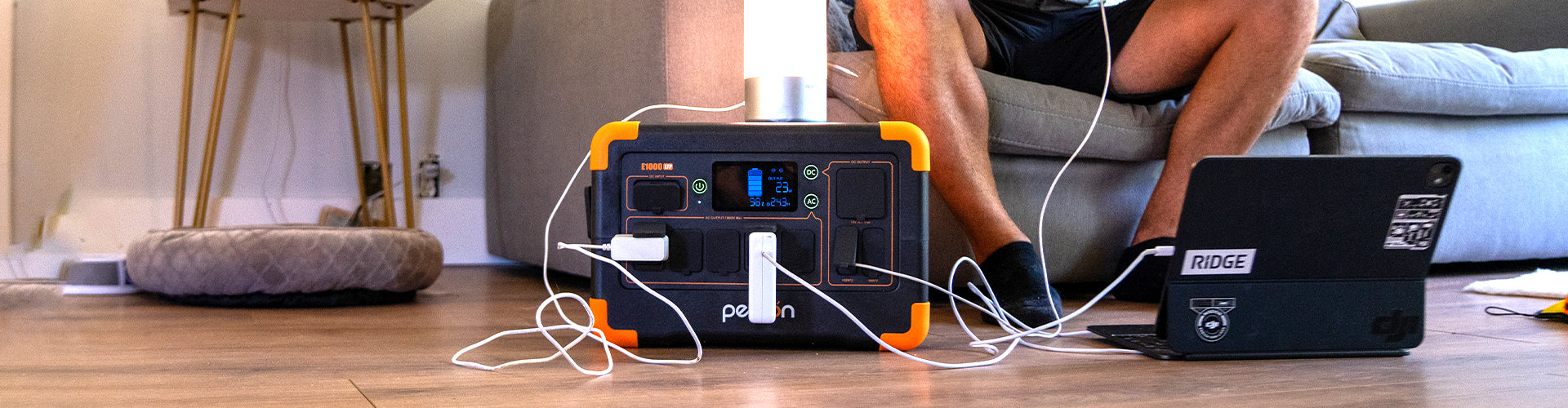
A system sized exactly to your daily draw provides zero margin for cloudy days, higher-than-expected fridge cycles, or any additional load you did not account for. A system sized at 1.5 to 2 times your daily draw gives you meaningful flexibility.
The practical sizing rule: choose a station where the real-world usable Wh (rated Wh times 0.85) equals at least 1.5 times your daily draw. For the 1,735Wh/day example above, that means a station with at least 1,735 times 1.5 = 2,602Wh of real-world output, which corresponds to a rated capacity of approximately 3,000 to 3,100Wh.
At Reserve Power Co., that maps to the AFERIY P310 at 3,840Wh rated (3,264Wh real-world) or the PECRON E3600LFP at 3,072Wh rated (2,611Wh real-world). Both cover the example load with meaningful buffer.
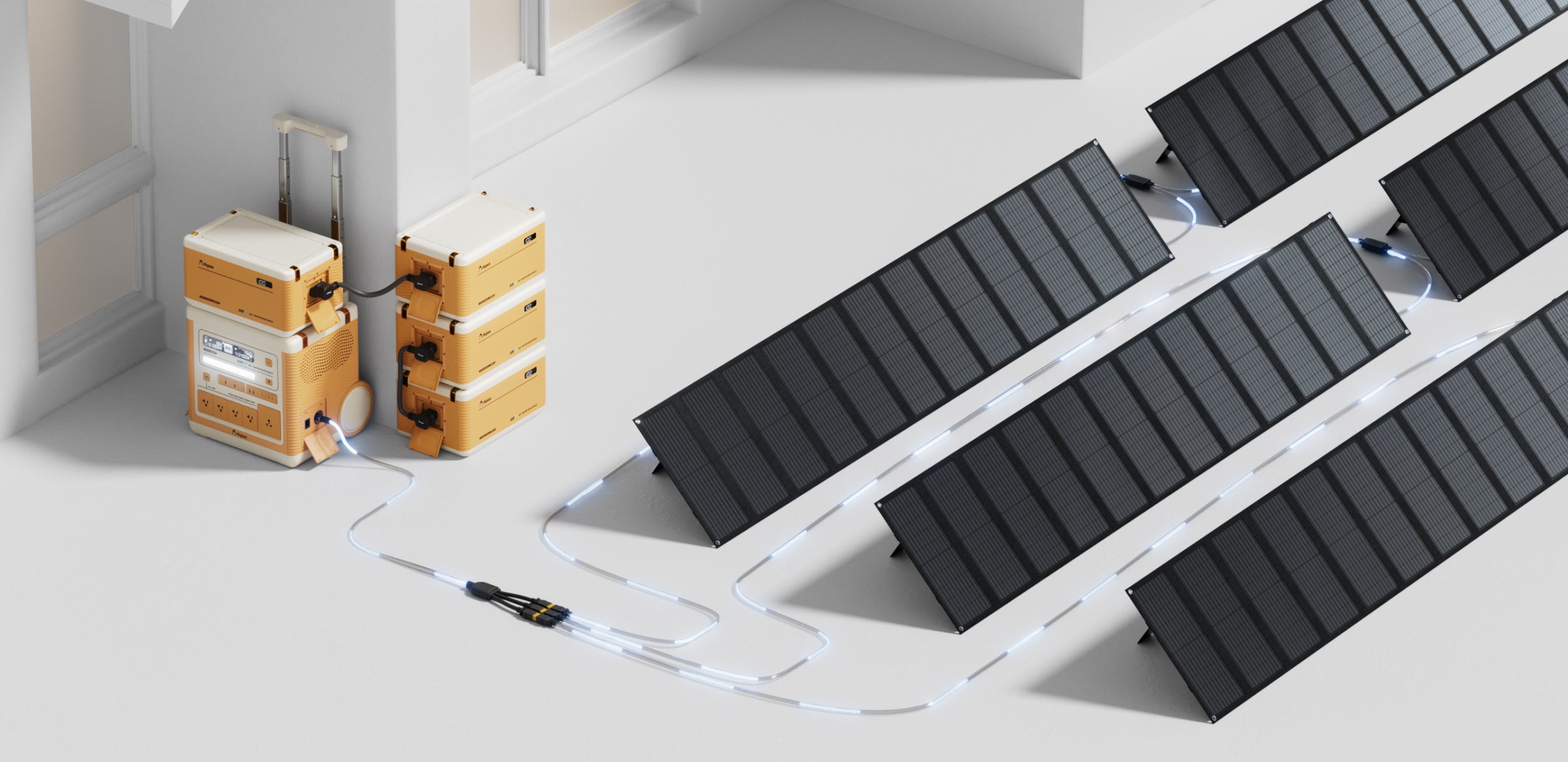
A power station without solar input is a finite resource. You discharge, you recharge from a wall outlet, and you repeat. Solar transforms the system from a battery bank into an indefinite power source, as long as you can generate enough to replace what you consume.
The target: your daily solar harvest should match or exceed your daily draw. Here is how to calculate required panel wattage:
In practice, you will lose some harvest to panel angle, temperature, partial shading, and wiring losses. A 20% safety margin on panel wattage is reasonable: for the example above, 385W times 1.2 = approximately 460W. Two 200W to 220W portable panels from our solar panel collection would cover this scenario.
All stations in the Reserve Power Co. lineup use MPPT (maximum power point tracking) charge controllers, which harvest 20 to 30% more energy from your panels in variable light conditions compared to non-MPPT controllers. This is a meaningful efficiency advantage that affects your real-world solar harvest daily.
Your power needs in month one of van life or your first hurricane season are not your power needs in year two. A station with an expansion battery path means you can grow your system without replacing the core inverter and management electronics.
The AFERIY P280 expands from 2,048Wh to 10,240Wh. The AFERIY P310 expands to 11,520Wh. The PECRON E3600LFP expands to 15,360Wh with four expansion batteries. For buyers who are not sure how large their system will eventually need to be, choosing a station with a clear expansion path protects the investment.
| Use case and daily draw | Recommended station | Key reason |
|---|---|---|
| Light camping, under 600Wh/day | AFERIY P280 | 2,048Wh base covers 3-plus days without solar. Expandable. Best weight-to-capacity ratio in the lineup. |
| Full-time van life or heavy camping, 800 to 1,500Wh/day | AFERIY P310 | 3,840Wh base with 1.5x buffer covers 2-plus days without solar. Expands to 11,520Wh. Sub-10ms UPS. 7-year warranty. |
| Home backup or heavy off-grid use, 1,500 to 2,500Wh/day | PECRON E3600LFP | 3,072Wh base, 1.5-hour recharge, expands to 15,360Wh. Fastest recharge for pre-storm loading. 4.86 stars, 44 reviews. |
| Marine, field work, or environments with rain/dust | Arkpax Ark NOA or Ark PRO | IP67 waterproof and dustproof. No other station on the market carries this rating. LFP chemistry, built for field conditions. |
{"one"=>"Select 2 or 3 items to compare", "other"=>"{{ count }} of 3 items selected"}